It was 2008 and the Beijing Olympics, few foreigners were being allowed to travel independently around China. We entered China via the now no longer-running boat up the Mekong form Thailand. The boat sailed through Myanmar on one side and Laos on the other, eventually y arriving in Jinhong 景洪市 Yunnan Province and the capital of Xishuangbanna 西双版纳.
Our Boat From Thailand to China 2008
It was in Jinhong, in the old, covered part of the market where we stumbled upon a tiny watch repair stall tucked between tea sellers and fruit vendors. The watch repairer* 修表匠 (*I am using the direct Chinese translation), an elderly Dai man, worked with delicate screwdrivers and a magnifying lens, surrounded by ticking relics. Locals brought everything from heirloom pocket watches to cheap digital pieces. He repaired each with patient care, chatting and laughing to his customers even while I was taking photos. Watching him at work felt like stepping into another era, where time moved slowly and craftsmanship still mattered to daily community life.
Strangely enough watch repairing hasn’t completely died out. In some parts of Madrid you can still find watch repairers (Relojeros) /修表匠) in small stalls in neighbourhood markets.
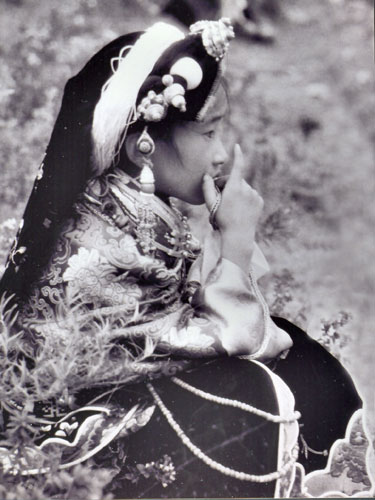
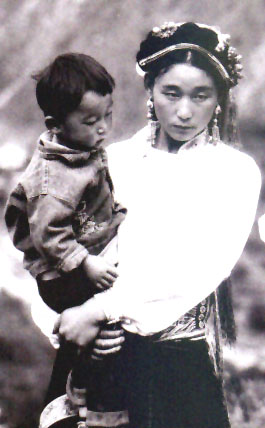
A blast from the past: The Danba festival, Sichuan 2004. Tibetan Qiang kids on their way to perform under the proud gaze of their parents. An amazing day:
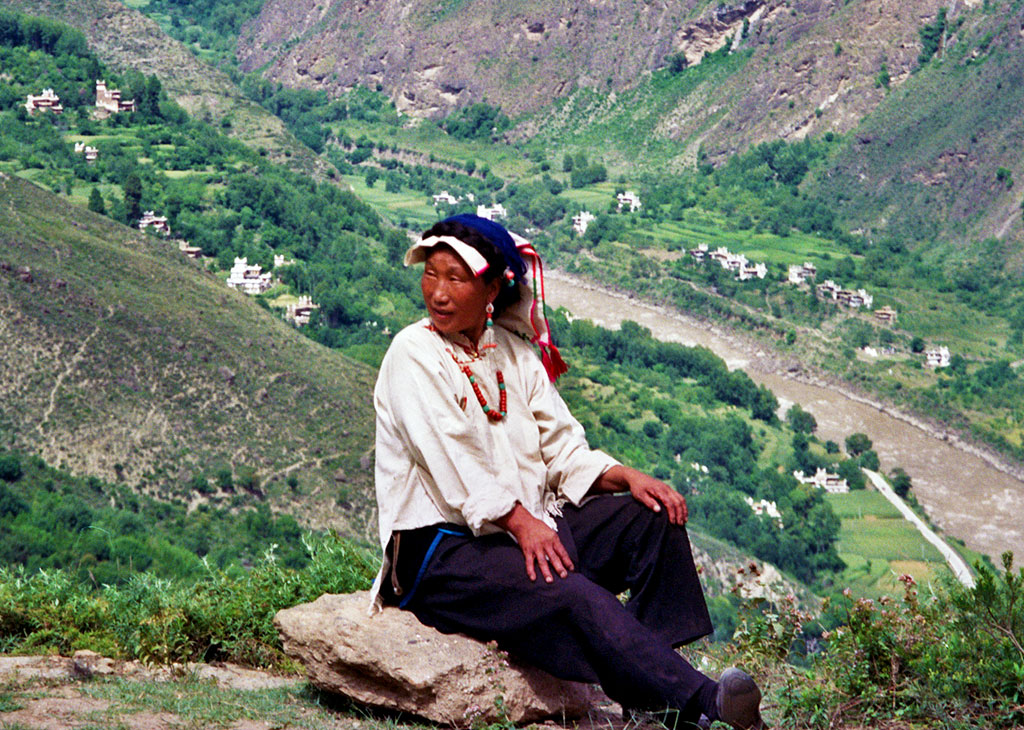
This photo was taken in August 2004 in Danba, Western Sichuan, China and the surrounding villages of Jiaju and Baidi. This was before Jiaju village was voted China’s number 1 most beautiful Village by Chinese National Geographic in 2005. We were the only forgeiners there at the time. It’s still a fantastic place.
Below are some photos we took of a Shanxi Opera performance in the city of Pingyao. Shanxi Opera is known as Jin Opera 晋剧 in China and it’s popularity has spread far further afield than just Shanxi Province.
Shanxi Opera Singer
It should be noted that most of the male roles are played by women
Pingyao is one of the centers of Shanxi OperaThe make up is really incredibleZZ Top Keeping him away with a stickThe musicians could look more inspiredThese musicians are doing better for now but soon tirea Belting voiceFantastic costumesSinging with emotionThis guy has attitudeAmazing hand movementsJust about to put in the punch lineAll the world’s a stage and we are just actorsI think she has played the tune a few too many timesGreat contrasting expressions
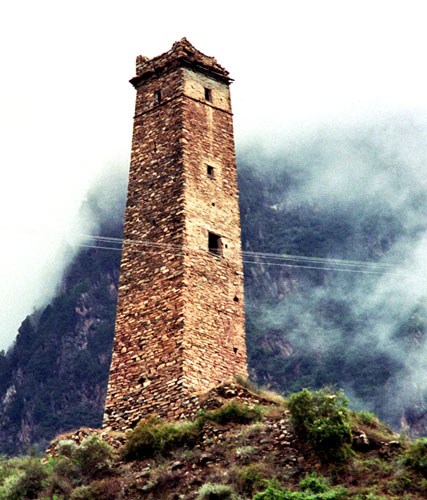
Three Days In Danba. From Kanding, Danba is approached through a deep valley where the road runs along- side a fast-flowing river. As you draw close to Danba, the first watch towers begin to appear on the hills on the other side of the river.
The towers
Danba Towers
The towers look a bit like industrial chimneys, but they are rectangular rather than round, though some of them have 6, 8 or even 13 corners. Some stand alone, while others form clusters. Their height ranges from 30 to 60 metres, the former being the most common.
Not much is known about the origin and use of these mysterious structures, which apparently can only be found in very few Tibetan areas. They are estimated to be between 200 and a thousand years old, and were almost certainly used for military purposes and to provide shelter for the population in times of danger.
The Aba prefecture of Sichuan province
However, the fact that some of them are huddled together in groups seems to contradict any military utility as look-out posts. Another theory therefore suggests that they might have been some kind of status symbols; their construction possibly related to the birth of a son. The Aba prefecture of Sichuan province seems to have the most, in particular the area of Danba and nearby Badi, where some 300 to 400 specimen remain. Many are still in an excellent state of preservation and can be visited easily.
Danba landscape and first towers
Danba itself is a rather ordinary small town with a great setting at the confluence of two rivers and towered by walls of rock. The town boasts several hotels, a number of small eateries, lots of shops and even a supermarket, as well as friendly inhabitants. Moreover, the surrounding countryside has a wealth of architectural gems to offer.
Traditional Houses Danba Region
not really having a clue about what to see or do in Danba
Armed only with a couple of brochures we had picked up at the Tourism Fair in Kanding, and not really having a clue about what to see or do in Danba, we approached a local taxi driver and hired him for 130 Yuan for the afternoon. He suggested that we should start our visit at a Tibetan village called Jiaju. The ride up there is beautiful: as you climb up the winding roads, the green hills surrounding you are dotted with small Tibetan settlements and punctuated by watch towers.
Jiaju Village
The architecture here is quite distinct, the farmhouses are sturdy square blocks, built in layers around an enclosed courtyard, and topped by towers and little turrets. The turrets and some of the layers are whitewashed, lending the buildings the wholesome appearance of cakes. In the available literature, this type of settlements is referred to as “stockaded” villages, though they are not surrounded by any actual fences. Perhaps “fortified” villages would be a more accurate description, given the high walls, narrow window slits and enclosed courtyards of the individual dwellings.
When we arrived at Jiaju, we were surprised to find that we had to buy a ticket to enter, and that the village had been listed as a potential Unesco Heritage Site. It is a stunningly beautiful place, though perhaps a little too perfect for our liking. The houses are clean, spacious and beautifully decorated: the frames of doors and windows are carved and painted in bright colours, flowers liven up the courtyards and small prayer-flags flutter between the turrets. Nowadays, many of these houses double up as guesthouses and offer meals.
The Highlight
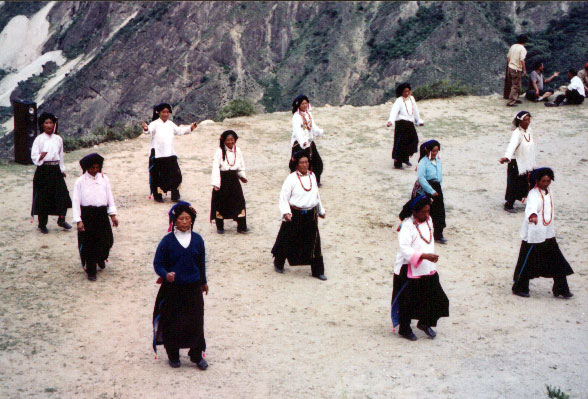
However beautiful the village, the real highlight of our visit to Jaiju was when we stumbled by coincidence on the local residents, rehearsing their songs and dances for the Danba festival, which was going to be held a few days later. The performers were wearing their traditional costumes. In the case of the women this consisted of a long black skirt with embroidered borders and belt, plus a white blouse with oversized, trailing sleeves, used for enhancing movements when dancing.
Their heads were covered in black embroidered cloths too, and they wore lots of bulky jewellery in which amber, coral and turquoise stones predominated. Though they looked very pretty and authentic, we were amused to see blue jeans and t-shirts popping out from underneath most of the young girls outfits!
the men were swaggering about in Chinese tunics and baggy trousers
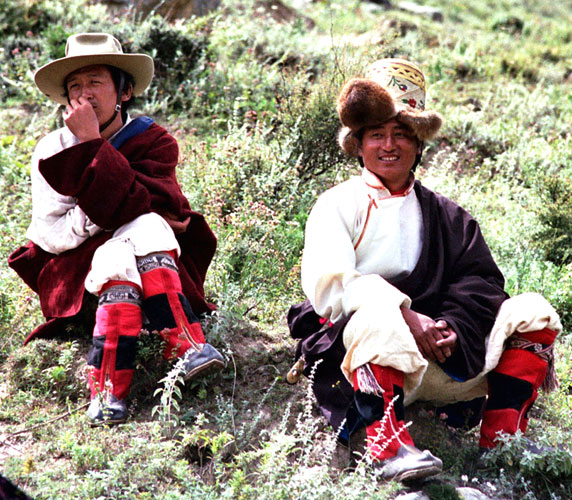
Meanwhile the men were swaggering about in Chinese tunics and baggy trousers, tucked into red and black hand-made leather boots with pointy, upturned toes. Oversized heavy Tibetan coats, with the characteristically long sleeves, were tied and draped around their waists or shoulders, while their heads were covered by curious, fur-lined pot-shaped hats with upturned flaps, or Mexican-style sombreros.
Rehearsals were being held on a small, stony platform, with the audience reclining on the grass of the surrounding hills. All performances, regardless of quality, were cheered and applauded: the young girls, twirling around gracefully, as well as the serious old men who pranced up and down the stage stiffly and gravely, thinking they were dancing. However, the show was definitely stolen by a group of squat little grannies who did a disco dance, albeit in slow motion, to American pop-music blaring from a couple of primitive speakers.
the village of Suo Po
After this, we back-tracked to the village of Suo Po, which is only a couple of kilometres away from Danba and has a superb group of watch towers. To reach the village, you have to cross a wood and steel suspension bridge, completely covered in prayer-flags, flapping furiously in the wind. However, once you are there, Suo Po is the real thing; the village is rural, beautiful and unchanged. It seems prosperous enough, with lots of orchards and vegetable gardens, and plenty of livestock, such as chickens, pigs and even yaks, wandering around. The old farmsteads are huge, multi-storied buildings with court yards and flat roofs. Some of them serve as guesthouses too.
the views from the top were spectacular
To get to the group of watch towers we had to climb up through the village, picking our way carefully over rocks and shrubs, accompanied by some village children and a couple of stray dogs. One of the topmost towers is hexagonal and perfectly preserved. Two local boys unlocked one of the towers for us, showing us how to work the ancient locks, as well as the remains of some ancient paintings, barely visible in the dark room at the base. They also allowed us to climb the tower, first on sturdy wooden ladders, but finally balancing precariously on a tree trunk with footholds carved out in it. However, the views from the top were spectacular and most certainly worth the effort.
Our destination was Badi
The next day we spent again with our driver, this time paying him 180 Yuan for the whole day. Our destination was Badi, one of the villages we had been told about by Mr Lee, the famous tourist guide in Chengdu (see the Chengdu section). Badi is no more than 35 kilometres from Danba, tucked a way in another valley, accessible only along a pretty poor stretch of road. In fact, the year before there had been major landslides at Badi and the surrounding area, killing more than 50 people, including 4 tourists from Shanghai, an event we were blissfully unaware of.
Ba Wang
On the way to Badi we passed the unremarkable white-tile village of Ba Wang, which houses a highly recommendable ancient temple and monastery that the monks claim is more than 800 years old. The carved and painted columns topped by animal heads, such as bears and stags, lend the temple a mystic and medieval atmosphere, which is quite moving.
The real treasure of the monastery
The real treasure of the monastery is to be found in a back gallery, guarded by a heavy curtain: there are some large colourful wooden statues, but more importantly, the walls behind the statues are covered in ancient, beautiful frescos depicting Buddhist scenes. Unfortunately, most of the frescoes are extremely deteriorated and the monks have no way or funding to restore them.
Badi, when we eventually got there, turned out to be not so much a village as an area, covering a group of small hamlets on both sides of the river and connected by swaying plank bridges with colourful prayer flags. The countryside is incredibly green, lush and fertile, with abundant fruit trees: you can find apples, pears, pomegranates, as well as chestnuts. There are endless opportunities for hiking in this area. You can choose, as we did, to go along the river from village to village, or climb into the mountains where there are more villages, watch-towers and breath-taking views.
“Model Family House for Tourist Reception”
Returning towards Danba, we stopped for lunch at what was called a “Model Family House for Tourist Reception”; agro-tourism Chinese style . The house was beautifully painted and decorated and boasted a wonderful covered terrace, where we ate a typical Tibetan meal, surrounded by plants and flowers. There were shredded potatoes, dishes of spicy cabbage, fried green peppers, purplish stalk vegetables, and cold noodles.
The old lady, our host, really impressed us by knocking up some tasty vegetation food; especially given that this is real meat-eaters’ paradise. We were particularly partial to the Tibetan flat bread, filled with strong goats’ cheese. Our driver meanwhile was happily tucking into portions of smoky dried pork and belly fat. We washed our feast down with strong local liquor, of which our driver luckily tasted little, and salty yak-butter tea.
Zhonglu
Finally, about 6 kilometres outside Danba, we visited the temple at Zhonglu, the biggest and principal monastery in the area. When we arrived, the monks were sitting cross-legged on the floor, eating an unappetising dinner of watery soup, with bits of meat floating in it. In spite of this, they were very welcoming and relaxed about our presence.
Much to our regret
Much to our regret, we had to leave Danba the next day. As we were heading out, just about all the Tibetans from the surrounding villages were making their way into town, dressed in their finest traditional clothes, adults as well as children. It was the Danba festival, and everyone was moving towards the sports stadium for a day of singing and dancing.
We consoled ourselves by saying that having seen the authentic thing at Jia Ju, it couldn’t possibly be as much fun to see it again in a more organised format. What’s more, watching everyone pouring into town for the festivities was good enough entertainment for the day.
Danba Practicalities:
Accommodation:
Hotel “Mei Ren Gu”, in the centre of town, overlooking the gushing river, is a friendly and clean family-style hotel with its own restaurant in the basement. Rooms are very reasonable at about 80 Yuan, though the toilets are squats.
There are plenty of other places to stay in town, some even looking rather flash. There are small restaurants, snack-bars and shops as well.
Transport:
There are some direct buses linking Kanding and Danba, but they do not run every day. An alternative solution is to take a share-taxi to Guza for 10 Yuan a person, taking about 30 minutes, and to pick up a mini-van from there, about 35 Yuan for 2 to 3 hours. Returning to Kanding, the situation is similar.
For excursions, it is relatively easy to hire a taxi for a day; expect to pay between 150 and 200 Yuan.
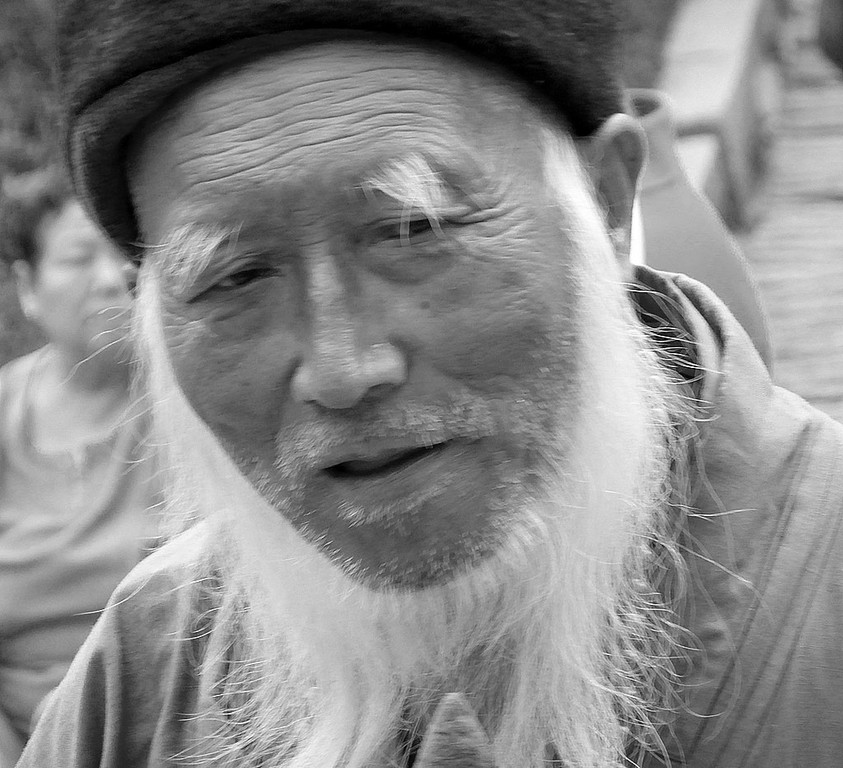
The Holy Man of Wutaishan: I thought I was bumping into a sage from China’s mystic past or even a larger than life Gandolf. The wispy beard and the implausibly brushy eyebrows harked back to an age of Chinese ledgends or Tolken’s Middle Earth.
The old monk was causing quite a stir; all the other monks, pilgrims and tourists were making an enormous fuss over him. Everywhere he went, he was stopped, greeted and revered.
The Holy Man of Wutaishan
Obviously, he must have been important figure in the world of Chinese Buddhism and his presence in Wutaishan shouldn’t have come as any surprise. There are few places more sacred to Chinese Buddhists than the 5 peaks of Wutaishan
The kids loved the staff
The kids loved him too; especially his pointed staff. Some kept trying to touch it’s tip, others tagged on to his orange robe.
We never found out who he actually was, but he was incredibly photogenic and I think he knew it.
.
Photogenic Monk or Gandolf
He smiled at me and the encouraged me to take some snaps. I must admit, I should have centered the camera better, but I was trying not to get in his way and that of his followers.
Changzi Accident Town 2016: It was one of those moments you will never forget. Our bus entered a tunnel close to the Shanxi city of Changzhi. In front of us was a small van, swerving slightly from side to side. Something was wrong. Was the driver drunk? Did they have a puncture? The traffic coming towards us on the other lane was relentless: lots of those enormous Shanxi coal trucks, fully laden and seemingly heading straight for our bus.
A quick decision
Changzhi Accident Town
The van in front suddenly stopped dead in its tracks. We were in seats 1 and 2, right at the front. The bus driver had a split second to make a decision. Swerve and risk hitting the oncoming traffic head on, or let the inevitable rear- end collision happen. Luckily, he chose the latter and I am here to tell the story.
As we smashed into the back of the van, the front windows of the bus shattered and my hands, braced for impact, were twisted backwards and I felt a sharp pain. On the oncoming lane, the stream of coal trucks kept passsing us one after the other, their drivers oblivious to what had just happened.
Changzhi Accident Town
We came to a grinding halt; the van was catapulted several meters in front of our bus by the impact, but fortunately not into the on- coming lane. There was a brief silence and then everyone laughed, relieved. My hands hurt but we were basically okay. We just had to flag down another bus.
January 2022
After our own experience, I should not have been that surprised to read about another traffic accident in the vicinity of the city of Changzhi; the very same city where we had been involved in that near fatal accident.However, the crash I read about in the international press was truly astonishing.
This time, what happened was far more incredible. Apparently, a heavy goods lorry driver had been misled by his GPS / Satnav and had been directed on to an incredibly torturous and precipitous mountain road, instead of a more accessible and suitable one.
Changzhi Accident Town: The Road to Shenlong Village
Shenlongwan village 神龙湾
This particular road in the vicinity of the city of Changzhi was built by hand by the villagers from Shenlongwan village 神龙湾 in the 1980s, keen to link their village with the outside world. It is exceedingly narrow, traverses numerous low tunnels and has huge drops into an abyss at every corner. In short, it’s totally unsuited to a huge, articulated lorry.
Old Photo building the Shenlongwan Tunel (not mine)
hammers and chisels
Hewn from the mountainside using hammers and chisels, the road took the villagers 15 years to construct between 1985 and 2000. Their endeavors have been rewarded by a surge in domestic tourists coming to visit the now accessible scenic area. Previously, the only access was via an ancient path of broken steps with vertical drops.
Old photo ancient path to Shenlongwan (not mine)
Amazingly, nobody was injured or killed in the incident and the lorry was retrieved and the road cleared again after 3 days of resue efforts. When you see the video footage (see video above), it seems inconceivable that the lorry didn’t plunge down the cliff.
off the beaten track
Tianji Shan (not mine)
The dramatic scenery in the video inspired me to investigate a little more and find out about things to see and do around Changzhi. When we passed through, it appeared to be a reasonably ordered and tidy town, but without much charm.
However, digging a little deeper I found some surprises. Changzhi is way off the beaten track, but it makes a good base for some interesting excursions. Apart from the Shenlongwan village 神龙湾 scenic area, there are plenty of other areas worth exploring. The most notable ones are the Taihang Shan mountains 太行山大峡谷 and the Tongtianxia Gorge 通天峡, the Ice Frozen Cave and the Taohuadong. Interesting villages include Hongni Cun and Monkey Village 猕猴寨. We’ll just have to save them for next time!
Shenlongwan (not mine)
Why were we passing by Changzhi?
Our bus that crashed had originated inPingyao. Our destination was Jincheng 晋城 , the closest town to Mr Chen’s Castle and the ancient city of Guoyu郭峪古城. Changzhi was where we had to change buses to get to Jincheng.
Chengyang Bridge and the surrounding Dong villages
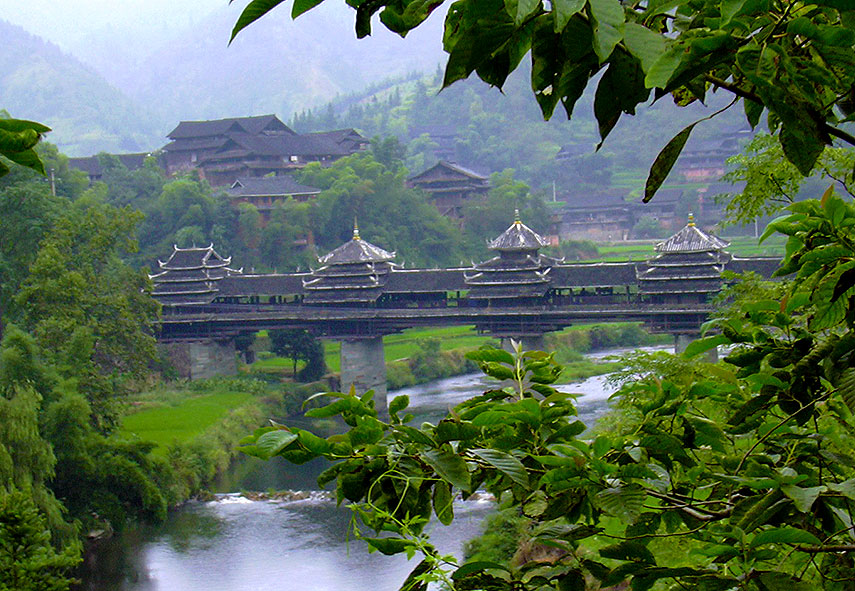
Nothing quite prepares you for your first sight of the bridge. Chengyang Bridge is what is known locally as a Wind and Rain Bridge. These covered wooden bridges were built with the purpose of literally protecting the farmers from the wind and rain and allowing people to sell their wares, sheltered from the elements.
The Bridge
Moreover, the bridge at Chengyang was built to help the locals cross the swollen Linxi River during the rainy season. The Chengyang (or Yongji) Wind and Rain Bridge is 64 meters long and 3.4 meters wide. Not one nail was used in its construction, which is said to have taken more than ten years and was completed in 1916.
On top of the bridge there are a number of beautiful eaved pavilions with one of them housing a small shrine. The whole structure rests on a number of sturdy stone columns that span the Linxi River.
Rural Charm and the Dong Minority
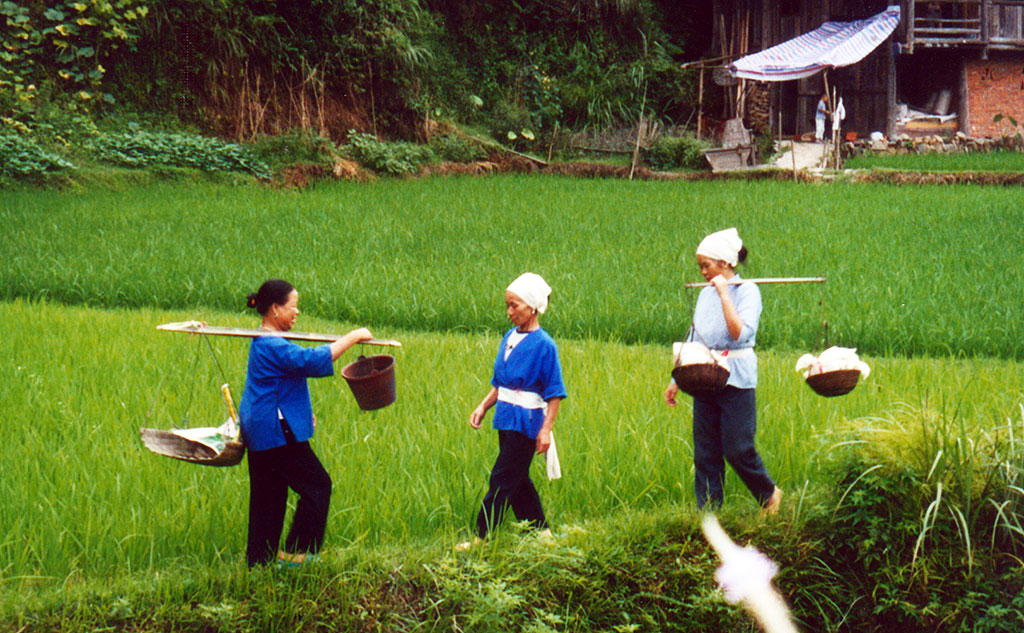
Dong farmers
However, Chengyang’s charm lies not only in its bridge. The whole area is beautiful and embodies much of what attracts so many people to Asia: the peaceful, rural scenery of rice paddies, swaying bamboo, slow moving waterwheels and traditional wooden villages.
Dong Muscians
Then, there are the colourful local Dong people with their unique culture and language, which is related to Thai. As they mostly live in isolated, forested areas, the Dong people have only recently come into contact with the outside world.
Dong Funeral
The Dong are best known for the elegance and the exotic features of their architectural designs. Apart from Wind and Rain Bridges, the second most important architectural characteristic of Dong villages are the Drum Towers.
The Drum Towers
Drum tower Chenyang Bridge
These incredible pyramid structures on stilts can be quite stunning, with beautifully carved statues and images of gods and musicians. Once used to warn the villages of impending danger, they now serve as a kind of communal hall, where locals gather to chat, play cards and enjoy a drink. And from what we saw, they can get pretty drunk!
Under the Drum Tower
There are plenty of hiking opportunities around Chengyang, taking you past many Wind and Rain Bridges, big and small, and through numerous Dong villages, all with their respective Drum Towers.
Under the Drum Tower
Chengyang Bridge and the surrounding Dong villages: The Villages
The village right by Chengyang bridge is called Ma’an and from here you can embark on a round walk that passes through two other villages, called Pingzai and Yanzai.
Around the Bridge and in Ma’an you may get accosted by Dong ladies, trying to sell you the purple ethnic jackets and embroidered halter tops that are typical in this region, but in the other villages there is nothing touristy whatsoever.
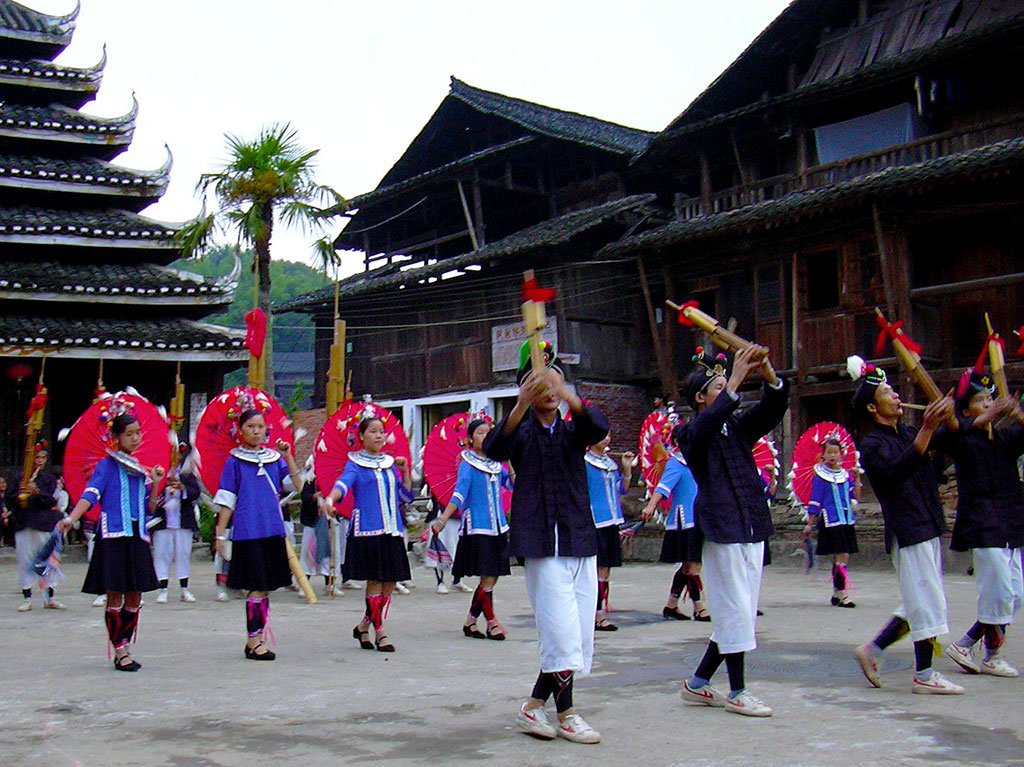
Overall, the Dong people seem pretty impervious to foreigners, neither being overly friendly, nor shy. During our stroll through the villages we came across a funeral and a jam session with long bamboo flutes, another Dong specialty, and on both occasions our presence didn’t cause a stir.
Dong Funeral
We can only hope that mass tourism, Chinese style, won’t wreak havoc on their culture.
Chengyang Practicalities
Before crossing the bridge you have to buy an entrance ticket, which at that time cost a mere 8 Yuan, and which also gives you access to the eight surrounding Dong villages. Once you have got your ticket, you can stay as long as you like.
Accommodation and Food:
We stayed at the atmospheric Chengyang Bridge National Hostel, a weathered wooden structure with a large veranda, right next to the Chengyang Bridge. Rooms are nice, with large beds covered in mosquito netting and views over the river and the waterwheels. Bathrooms are shared, but clean. One word of warning: arachnophobes, such as Margie, may be unpleasantly surprised by the large, fast-moving spiders that tend to hang out in the bathrooms!
Food at the hostel is simple but good and the covered veranda is a great place to enjoy evening beers and meals. Simple snacks are available in some of the villages as well.
The friendly and helpful owner of the hostel, who calls himself Lao Wu, is an excellent source of information on what to do in the area. Among other things, he can provide you with hand-drawn maps and instructions for walks. He also hires out his minivan for excursions, or to take people to the bus station.
Local Transport around Chenyang Bridge
Onward Travel:
Dong Dancers at Chenyang
If you are heading to Zhaoxing, there is a direct bus leaving from Songjiang at 6.30 am. The owner of the hostel may give you a lift to Songjiang to catch this bus for around 40 Yuan, especially if he is going into town to pick up supplies.
If you wish to stay longer and explore some of the other Dong villages in the area, then Songjiang is the best base from which to reach them.
Dong Dancers at Chenyang
Update
These days Roads are better and faster. Furthermore there is now a highspeed rail link joining these areas. Incredible when you think about it; 20 years ago this was an exotic off the beaten track experience.
Dong Dancers
We would love to know if the Chengyang Bridge National Hostel still exists?